
Tech Control Beyond the Console — DirectOut Maven.A
Anyone who has ever worked with me knows that I enjoy constantly tinkering. I like to move, adjust, rearrange, and reorganize gear until it serves its purpose in the most optimal way for my workflow. One of the pieces of gear that I have been fortunate enough to work with this year is the DirectOut Maven.A.
For those unfamiliar, the DirectOut Maven is part of the same smart platform that the Prodigy.MP (as well as the MC and MX) comes from. It is essentially half of an MP, with its single network type A slot and two conversion type C slots. It also has two MADI SFP slots. The way I have my particular Maven configured is:
- One (1) Dante.SRC.IO Type A Card
- Two (2) MIC8.LINE.IO Type C Cards
- Two (2) Coaxial Mini BNC SFP MADI modules
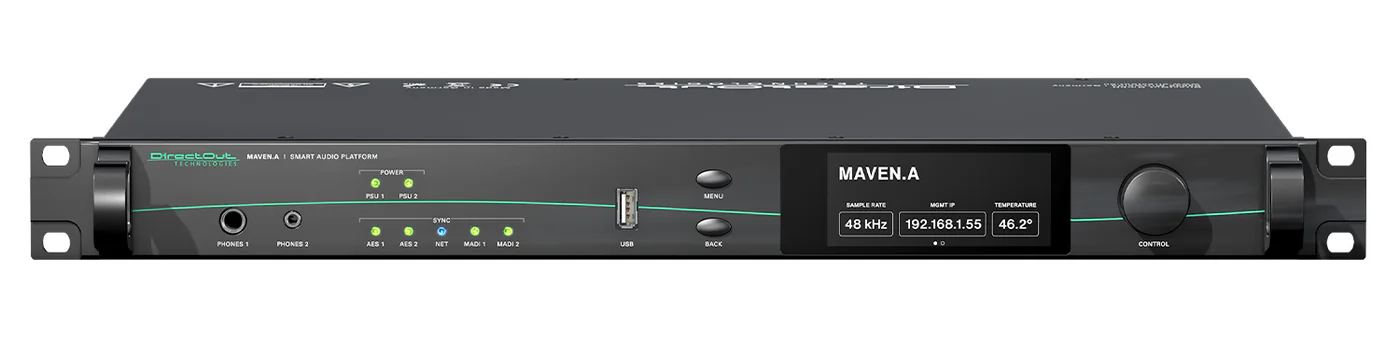
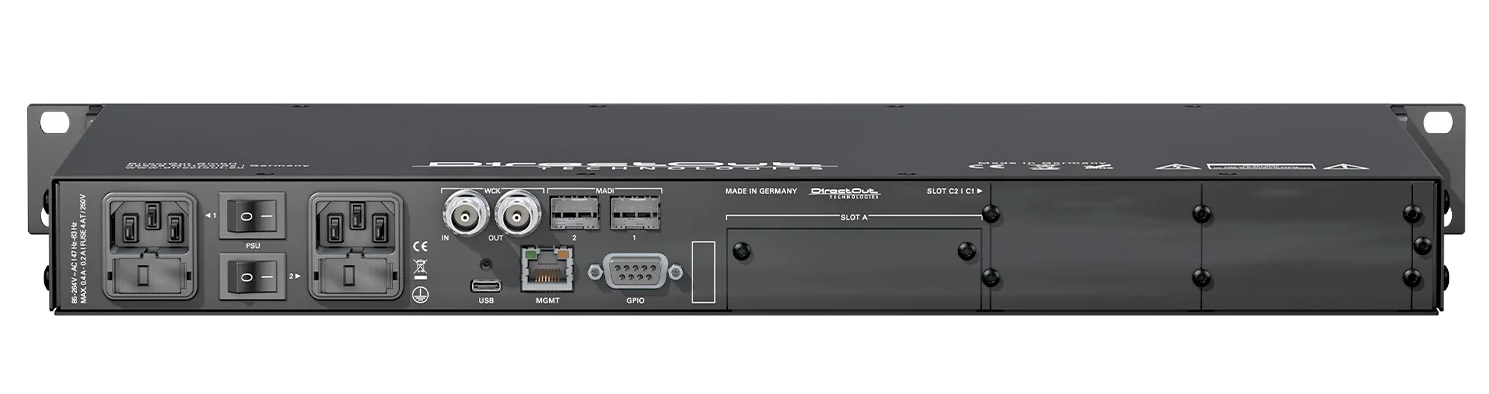
Maven.A Front and Rear Panel with a blank configuration
The DirectOut (DO) smart platform at its core is built around the idea of making any signal flow possible as long as you have the right connections. It is a robust and flexible hub in a complex web of protocols and constantly evolving audio needs. There are so many possibilities of what this platform could do, but today I just want to tell you about one.
Many monitor engineers have integrated Bitfocus’ Companion software into their rigs due to the ability to give their audio and backline techs control of things like talkbacks, solos, etc. Despite the simplicity of connecting a couple of Stream Decks or emulator webpages to a DiGiCo console, there are a few limitations that I wanted to find my way around.
First, this is limited to consoles that support an extensive macro control system that can be controlled over a network protocol like OSC.
Additionally, there are limitations when it comes to connecting the DiGiCo macros to Companion based on how DiGiCo provides access to said macros on the network. This can result in issues such as macros becoming out of sync, missing macro commands, and ultimately not being integrated fully.
Lastly, when controlling things like soloing instruments, the engineer is limited when trying to virtual soundcheck because it hijacks the inputs that the techs may be trying to work on.
So how does the Maven solve these problems?
First, with the Maven being a third-party device, it allows for integration into any audio system. DirectOut offers so many protocol options that connecting it to any console system is a non-issue. It also makes this type of control somewhat agnostic to the show file, in that it could carry over show to show without changing much or rebuilding tech control into every show file.
Second, DirectOut has created a native Companion module to control their smart platforms. Best of all, it speaks natively to the device, so there is no need to have Globcon (the desktop control software for the Maven) open. Once configured, everything programmed can be controlled directly from the commands in Companion. All feedbacks are native and do not require additional programming like DiGiCo macros do. This is also a benefit because if things are not connected at the start of the day, Companion will poll the machine to determine the status and adjust feedback accordingly. If you have worked with DiGiCo macros fired from Companion, you will most likely know the pain of having to re-sync all of your tech macros at the top of the show day when you boot up.
Third, and my main reason for explaining my use case, is that it essentially becomes a second audio console. On this tour, one of the techs wanted to test a few lines in rehearsal while I was working in virtual soundcheck. This sparked the idea of using the Maven as an isolated solo directly from the preamp. A lot of times techs will use the phrase, “Can you solo X instrument for me?” This is a completely valid request, but if you understand how monitor consoles work, this is not exactly something you can do easily.
So how do I have this set up?
Before I give you the signal flow, I want to discuss the clocking because anytime you introduce additional digital audio devices, clocking should be the first question. My audio system is at 96k, but I only have two MADI inputs. At 96k this is only 32 channels per MADI input and I have a 56 channel rack and a 32 channel rack I would like to be able to monitor. What I have done is set the Aux Split MADI on both the SD Rack and the Mini rack to use the internal SRC to output all channels at 48k. This means one MADI stream is the SD rack and the other MADI stream is the Mini rack. The Maven operates at 48k clocked by the SD rack MADI input.
My signal flow is as follows:
SD Rack 1.11 and Mini Rack 1.12 Aux MADI Split Out
↓
MAVEN.A SFP MADI Coax Inputs
↓
MAVEN.A Summing Buses
↓
Dante.SRC.IO Card Output
↓
Dante to MADI Interface with SRC into Console
Now, in my rig, the way the Maven outputs back into the console is a bit convoluted. There are several ways to do it, and I found a way to do it with the gear I had. Ideally, the Maven would SRC the OUT of the SFP MADI Mini BNC and go directly into the console, but my MAVEN does not have that license. I had to get creative. I used a Dante to MADI converter with an SRC that brought it back up to 96k.
All I am actually outputting are three stereo summing buses; a keys tech summing bus, a guitar tech summing bus, and a monitor tech summing bus. I then take those stereo buses into the desk as stereo channels, fed discretely to each of their respective tech mixes. This allows each one of those people, through companion, to solo the direct preamps without being interrupted by anything on my desk. Of course, they do not hear any processing I am doing, but I generally do not do much processing anyway. This all happens without any complex macros, difficult to follow aux on-off, or interruption from VSC.
This idea is not new. There are many systems that can accomplish the same thing. But what is new to me is the idea and ability to isolate my tech control through one piece of gear that is much cheaper than a second console or full-blown tech system. It integrates seamlessly into protocols already present in the rig, and coexists with DiGiCo control for things like talkbacks. Overall, it has been a useful addition. Let me know if you have any indispensable tech control macros or integrations.
